
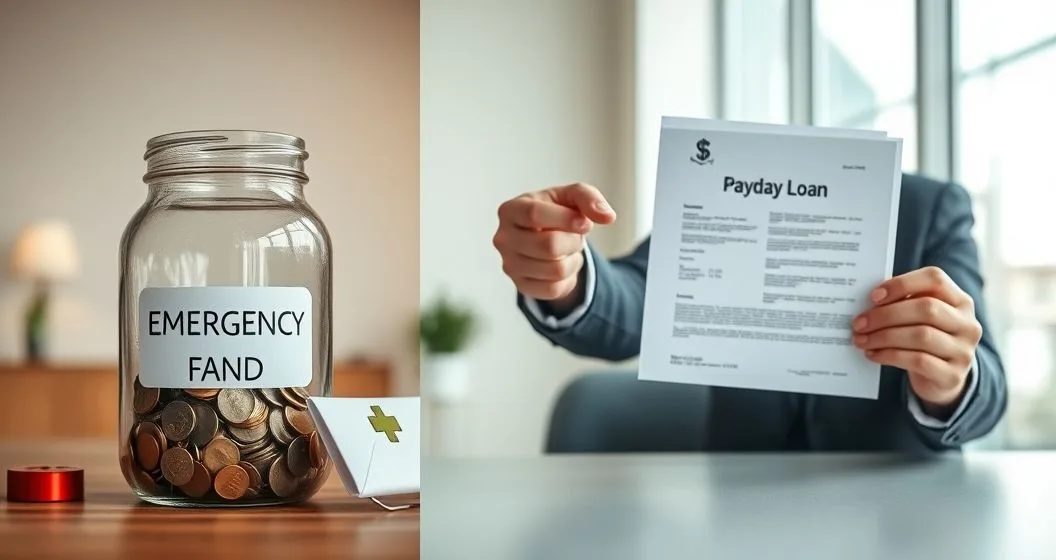
What’s the difference between emergency funds and payday loans?
When you face an unexpected bill—medical care, car repair, or a temporary income gap—you generally have two broad paths: tap your own savings (an emergency fund) or take a quick-paid loan (often a payday loan). The practical difference is simple but powerful: emergency funds cost you time to build but protect you from high interest and repeated fees; payday loans provide speed at a very high price and frequently lead to longer-term financial distress if used more than once.
In my 15+ years advising clients, the pattern is clear: people with a dedicated emergency fund avoid the short-term panic and compounding costs that come with repeated payday-borrowing. Conversely, I’ve seen clients trapped in rollover cycles that turn a $400 need into several times that amount within months.
Sources: Consumer Financial Protection Bureau (CFPB) research on payday lending and guidance on building savings (consumerfinance.gov) and National Consumer Law Center analysis on high-cost loans.
Why emergency funds are the safer backup
- Cost: Emergency funds earn interest (often small) rather than costing it. Even a modest high-yield savings account reduces purchasing power loss from inflation and avoids loan fees.
- Control and flexibility: You decide when and how much to withdraw. There’s no lender imposing repayment or rollovers.
- Psychological benefit: Knowing you have a cushion reduces panic-driven decisions that can lead to poor financial choices.
Practical target: Start with a $1,000 mini-fund to cover small shocks, then build toward three months of essential living expenses—longer if you’re self-employed, gig-working, or have irregular income (6–12 months may be appropriate). See our step-by-step guide for building this buffer: How to Build an Emergency Fund: Step-by-Step Plan.
Where to keep an emergency fund
Keep these principles in mind: liquidity, safety, and some yield. Recommended places include:
- High-yield savings accounts (online banks often outperform brick-and-mortar savings rates)
- Money market accounts or short-term cash sweep accounts
- Tiered buckets: immediate cash (checking or easy-transfer savings) for the first month, short-term savings for months 2–3, and a recovery bucket for longer reserves (see: Emergency Fund Tiers)
Avoid tying emergency money to investments with market risk (stocks, long-term CDs with penalties) because forced early withdrawals can compound losses.
Why payday loans are risky as a backup plan
Payday loans are designed to be repaid on your next payday. They’re attractive because of speed and minimal underwriting, but the cost is the problem. Many payday loans effectively charge APRs in the triple or quadruple digits once fees and rollovers are considered. A CFPB review and multiple state studies show borrowers often re-borrow or roll loans, trapping them in cycles of fees and growing balances.
Common payday loan features that create risk:
- Short repayment window that doesn’t match true recovery time
- Automatic bank withdrawals that can trigger NSF fees if funds are insufficient
- Rollovers or repeated renewals that add fees rapidly
For safer short-term borrowing, consider credit union payday-alternative programs, short-term installment loans with transparent amortization, or small-dollar loans that cap APRs. Our guide to Payday Loan Alternatives: Safe Options to Consider lists community resources and lower-cost options.
Real client scenarios (anonymized)
-
Jane (single-earner household): Built a $15,000 emergency fund over 3 years. After an unexpected layoff, she used the fund to cover essential costs for six months while she found new employment. Her savings prevented debt accumulation and allowed her to negotiate severance and a thoughtful job search.
-
Mark (rolled loans): Took a $500 payday loan for an urgent auto repair. Unable to repay within two weeks, he rolled the loan twice and paid nearly $300 in fees over two months. The short-term convenience led to a substantially higher cost and stress. He later used a debt-education program to break the cycle.
These examples match patterns reported by consumer advocates and federal research: emergency savings reduce the probability of high-cost borrowing, while payday loans frequently increase financial vulnerability when used as a primary emergency source (CFPB).
Practical, prioritized plan: build the safety net (step-by-step)
- Set a near-term goal: $1,000 mini-fund. Automate a weekly or monthly transfer—out of sight reduces spending friction.
- Build to 3 months of essentials. List fixed monthly costs (housing, food, insurance, minimum debt payments) and multiply by three. Adjust upward if you’re self-employed.
- Use tiered liquidity: immediate (1 month) in checking or ultra-liquid savings; short-term (months 2–3) in a high-yield savings account; recovery (months 4+) accessible but slightly less liquid.
- Keep separate from long-term investments and retirement accounts to avoid early withdrawal taxes and penalties.
- Replenish quickly after use: set a small direct deposit or round-up program until full.
If you can’t reach these goals immediately, prioritize the mini-fund and look for supplemental options below.
Safer alternatives to payday loans (ordered by recommended preference)
- Credit union small-dollar loans: Often lower APRs, member-friendly underwriting, and more reasonable repayment terms.
- Short-term installment loans from regulated lenders: Payable over several months with clear amortization and lower effective APRs than payday advances.
- Emergency assistance programs: Local nonprofits, churches, and community action agencies sometimes provide grants or interest-free loans.
- Negotiation: Call your creditor, utility, or landlord—many will offer payment plans or short deferrals when told about hardship.
- Family or trusted friend loans with a simple written plan: Less costly if structured respectfully.
See community resources and comparison details in our Payday Loan Alternatives: Safe Options to Consider and Community Programs That Prevent Payday Loan Dependence.
Quick decision checklist when crisis hits
- Do I have an emergency fund I can use without penalty? If yes, use it.
- If no: can I access a credit union small-dollar loan, or a short-term installment loan with fixed, disclosed costs?
- Can I defer or negotiate the payment instead of borrowing?
- If considering a payday loan, calculate the total repayment (fees + principal) and compare to alternatives.
Use the CFPB’s consumer tools to estimate costs and learn your legal protections (consumerfinance.gov).
Common mistakes to avoid
- Treating credit cards as emergency funds: cards have limits and high interest if not paid off quickly.
- Relying on payday loans as a routine safety net: repeated use is a predictor of long-term financial stress.
- Keeping emergency savings in accounts that are hard to access or subject to penalties.
Quick resources and further reading
- How to Build an Emergency Fund: Step-by-Step Plan — a practical roadmap to start and automate savings. (internal link: https://finhelp.io/glossary/how-to-build-an-emergency-fund-step-by-step-plan/)
- Payday Loan Alternatives: Safe Options to Consider — comparisons and community solutions to avoid predatory borrowing. (internal link: https://finhelp.io/glossary/payday-loan-alternatives-safe-options-to-consider/)
- Emergency Fund Size: How Much Should You Really Save? — sizing guidance for different life stages. (internal link: https://finhelp.io/glossary/emergency-fund-size-how-much-should-you-really-save/)
External authoritative resources:
- Consumer Financial Protection Bureau — Payday Loans overview and consumer tools: https://www.consumerfinance.gov/consumer-tools/payday-loans/
- Consumer Financial Protection Bureau — Savings and emergency funds guidance: https://www.consumerfinance.gov/consumer-tools/saving-money/
Professional disclaimer
This article is educational and reflects common best practices and my professional experience advising clients. It is not personalized financial advice. For individualized planning, consult a certified financial planner or a credit counselor who can review your specific circumstances and state laws.
Action steps (one-week plan)
Day 1: Create a one-page budget and identify non-negotiable essential expenses.
Day 2: Open a high-yield savings account if you don’t have one.
Day 3: Automate a recurring transfer—even $25/week helps build momentum.
Day 4: Identify a credit union or community lender as your backup alternative.
Day 5: Save a $1,000 mini-fund target and draft a 3-month plan to continue building.
Taking structured actions now reduces the odds you’ll need a payday loan later. Prioritizing liquidity, planning, and alternatives protects both your finances and your peace of mind.


