
Overview
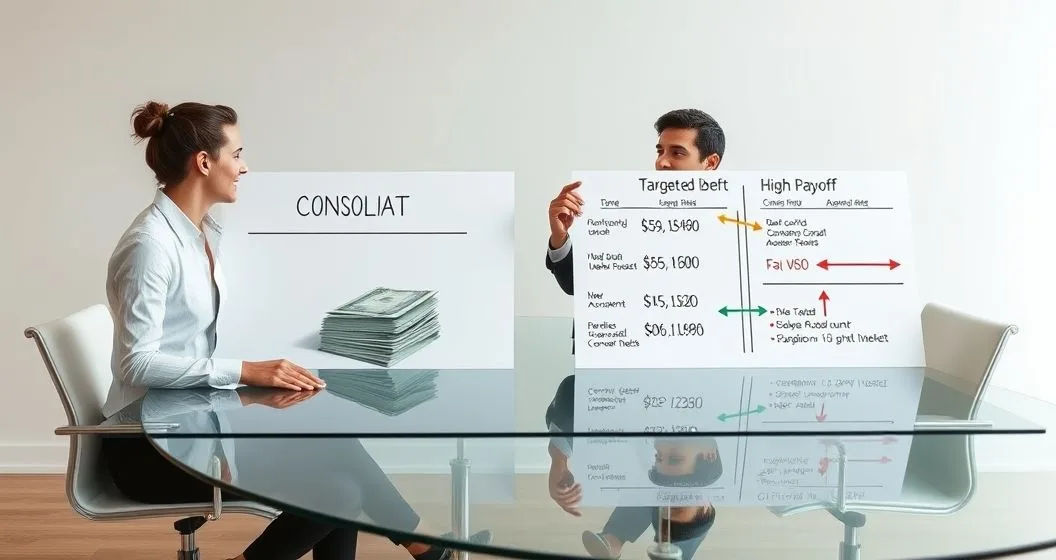
Debt consolidation and targeted payoff strategies both use personal loans as a tool, but they solve different problems. Debt consolidation replaces multiple balances with one loan. Targeted payoff strategies keep multiple accounts but use a personal loan strategically to reduce the cost of one or more high-interest balances while preserving flexibility.
This article explains how each approach works, who benefits, how to run the numbers, common pitfalls, and practical next steps you can follow today. I’ll include examples from my years advising clients and cite authoritative sources so you can verify the guidance (Consumer Financial Protection Bureau, Investopedia, and other consumer resources).
Sources: Consumer Financial Protection Bureau (CFPB) — “What is debt consolidation?” https://www.consumerfinance.gov/ask-cfpb/what-is-debt-consolidation-en-1960/; Investopedia — “Debt Consolidation” (overview) https://www.investopedia.com/terms/d/debt-consolidation.asp
Core difference in one sentence
Debt consolidation replaces many payments with one loan to simplify and possibly lower your rate; targeted payoff strategies prioritize which debts to pay sooner (using extra payments or a selective personal loan) to reduce interest or behavioral risk.
How debt consolidation with a personal loan works
- You apply for a personal loan sized to pay off existing accounts (credit cards, medical bills, smaller loans).
- The lender issues one lump sum; you use it to pay creditors and begin a single monthly payment to the new lender.
- Goal: reduce the weighted-average interest rate, lower monthly payments, or both.
Pros
- One payment and a predictable amortization schedule.
- Potentially lower interest and lower monthly payment if you extend the term.
- Easier budgeting and fewer missed payments.
Cons
- Extending term can increase total interest paid over the life of the loan.
- If you don’t change spending habits, you may re-accumulate credit card debt.
- Some lenders charge origination fees or prepayment penalties; compare offers.
When it helps
- You have multiple high-rate revolving balances (credit cards) and can qualify for a lower-rate personal loan.
- You want a firm payoff schedule and simpler bill management.
Practical resource: If you want a step-by-step approach to consolidating with a personal loan, see our guide “Debt Consolidation with Personal Loans: A How-To” (internal): https://finhelp.io/glossary/debt-consolidation-with-personal-loans-a-how-to/
How targeted payoff strategies work (snowball and avalanche)
Targeted payoff strategies do not automatically combine accounts. Instead, they set a priority order for extra payments:
- Snowball: pay smallest balance first for momentum.
- Avalanche: pay highest-interest balance first to minimize interest costs.
Using a personal loan as a targeted tool
- You might take a small personal loan specifically to wipe out one very high-rate account (e.g., a 24% credit card) and leave other debts untouched.
- Or you use a personal loan to create a short-term cash buffer to accelerate payments via an avalanche schedule.
Why choose targeted payoff
- Keeps certain loan terms and benefits intact (for example, student loan protections).
- Prevents the psychological risk some borrowers face when consolidating everything: seeing one low monthly payment may encourage additional borrowing.
Internal link: For help weighing snowball vs. consolidation choices, read “When to Use Debt Consolidation vs Snowball: A Simple Guide” https://finhelp.io/glossary/when-to-use-debt-consolidation-vs-snowball-a-simple-guide/
Decision checklist: Which is likely best for you?
Run these five checks before applying for a personal loan:
- Interest math: Calculate the weighted-average interest rate of your existing debts. If a personal loan’s APR is meaningfully lower, consolidation can save interest.
- Term tradeoffs: Will the loan lengthen your repayment timeline? Lower monthly payments can increase lifetime interest.
- Fees and costs: Include origination fees, prepayment penalties, or balance-transfer fees in your comparison.
- Behavior and discipline: Are you likely to stop using paid-off credit cards? If not, consolidation can worsen your situation.
- Special loan protections: Don’t use a personal loan to pay federal student loans unless you understand what you’ll lose (income-driven plan eligibility, loan forgiveness pathways).
Tool tip: Use a free amortization calculator to compare total interest paid and monthly payments across scenarios.
Example comparisons (simplified math)
Example A — Debt consolidation saves money
- Balances: three credit cards, total $12,000 at average 20% APR, mixed minimum payments ~ $360.
- Personal loan offer: $12,000 at 10% APR for 4 years:
- New payment ≈ $304/month.
- Interest saved: substantially lower monthly interest and predictable payoff schedule.
Example B — Targeted payoff using a personal loan
- Situation: $8,000 total debt made of two cards — $2,500 at 24% and $5,500 at 12%.
- Strategy: take a $2,500 personal loan at 9% to eliminate the 24% card immediately. Continue avalanche payments on the remaining 12% balance.
- Result: immediate reduction in the highest-cost interest, and you keep the lower-rate loan separate.
These examples are illustrative. Run the numbers with your exact balances and APRs. A small rate difference can matter greatly when balances are large or terms are long.
Common mistakes and how to avoid them
- Mistake: Consolidating and then opening new credit cards. Fix: Close impulse lines or freeze new card applications until you’ve made steady progress.
- Mistake: Ignoring origination fees. Fix: Add fees into the comparison and calculate the break-even horizon.
- Mistake: Using a personal loan for federal student loans without understanding repercussions. Fix: Confirm with Federal Student Aid or a student loan counselor before refinancing federal loans.
Authoritative guidance: The CFPB publishes plain-language information on debt consolidation and safe practices: https://www.consumerfinance.gov/ask-cfpb/what-is-debt-consolidation-en-1960/
How consolidation affects credit scores
- Short term: Applying for a loan triggers a hard credit inquiry that can cause a slight dip.
- Medium term: Consolidation can lower your credit utilization (if you pay off revolving cards), improving your score.
- Long term: If you close paid-off accounts, you may shorten your credit history and raise utilization. Keep paid accounts open when possible and use them sparingly.
For deeper reading about utilization effects, see our internal resource “How Debt Consolidation Loans Affect Your Credit Utilization”: https://finhelp.io/glossary/how-debt-consolidation-loans-affect-your-credit-utilization/
Steps to implement either plan
- List every debt, APR, minimum payment, and due date.
- Compute your weighted-average APR and total monthly minimums.
- Get personalized loan quotes from multiple lenders (credit unions, online banks, and traditional banks). Include origination fees.
- Model the scenarios: consolidation vs targeted payoff (amortization schedules, total interest paid).
- Choose a plan and set up automated payments to avoid missed payments.
- Re-evaluate quarterly and adjust if your income or expenses change.
Remember: a lower monthly payment can ease cash flow but may extend your payoff time. Decide whether your priority is lower monthly cash flow today or lower total interest over time.
Frequently asked practical questions
- What credit score do I need? Many lenders prefer 650–700+ for the best personal loan rates, but offers exist for lower scores. Check each lender’s criteria.
- Can I consolidate all debts? Most unsecured debts (credit cards, medical bills) are eligible; federal student loans and secured loans (like mortgages) have special rules and protections.
- Will consolidation stop creditors from calling? Consolidation replaces your accounts, so creditors should stop collection calls for the consolidated balances, but check account closure and payoff confirmation.
Final recommendations (professional insight)
In my practice I’ve seen the biggest wins come from combining technique with behavior change. Consolidation works well when it is part of a plan that closes or freezes paid-off credit lines and creates a monthly budget that prevents re-borrowing. Targeted strategies work well for people who need psychological wins (snowball) or who must preserve certain loan features (avalanche with tactical personal loans).
If you’re unsure which route to pick, first run the interest math and then be honest about likely future behavior: will you be tempted to charge again, or will a single payment help you stay on track?
Professional disclaimer
This content is educational and does not constitute individualized financial or legal advice. For decisions about debt consolidation, refinancing, or loan selection, consult a qualified financial advisor or credit counselor and the lender’s disclosures. Official consumer guidance is available from the Consumer Financial Protection Bureau: https://www.consumerfinance.gov/
Additional resources
- CFPB: What is debt consolidation? https://www.consumerfinance.gov/ask-cfpb/what-is-debt-consolidation-en-1960/
- Investopedia: Debt consolidation overview https://www.investopedia.com/terms/d/debt-consolidation.asp
- For practical consolidation how-to, see: “Debt Consolidation with Personal Loans: A How-To” (FinHelp) https://finhelp.io/glossary/debt-consolidation-with-personal-loans-a-how-to/
- For strategic comparisons: “When to Use Debt Consolidation vs Snowball: A Simple Guide” (FinHelp) https://finhelp.io/glossary/when-to-use-debt-consolidation-vs-snowball-a-simple-guide/
If you want, I can run a sample calculation using your exact balances and rates to show the savings (or cost) of each approach.


