
Quick overview
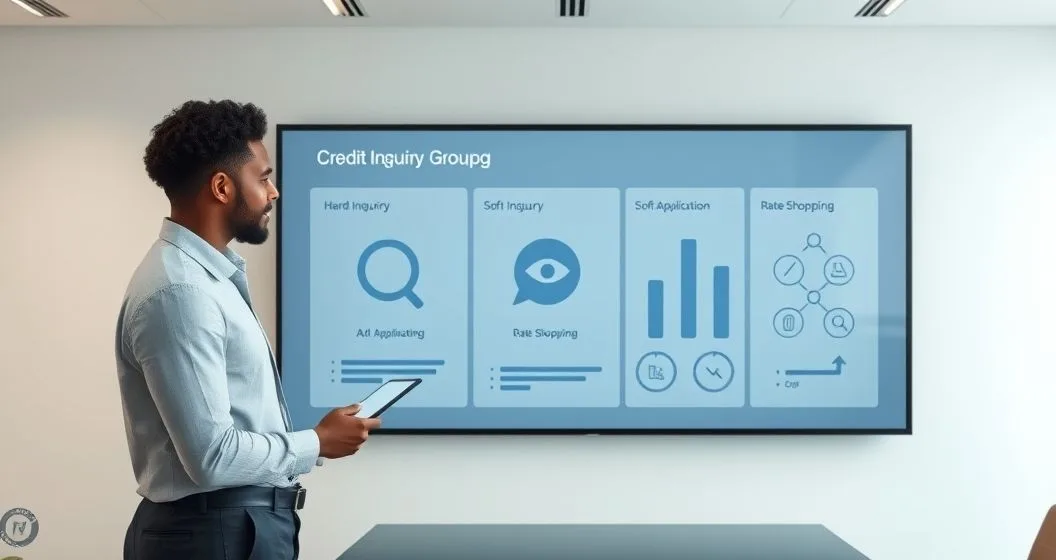
Credit inquiries show who has requested a copy of your credit report. Most scoring models treat inquiries in one of three ways: as soft inquiries (no score impact), hard inquiries (may lower score briefly), or grouped hard inquiries when multiple lenders check your file while you shop for the same loan. How those groups are defined depends on the scoring model and its version, so the effect on your score can vary.
Why grouping matters
Grouping prevents consumers from being penalized for rate shopping. Without grouping, someone comparing offers from several lenders could see multiple hard inquiries and an unnecessary hit to their score. Scoring models avoid that by counting several same‑purpose checks within a short timeframe as a single inquiry for scoring purposes. The exact time window and the types of loans covered (auto, mortgage, student) depend on the scoring system.
What the models actually do (and what differs)
-
Soft inquiries: These appear on your report for informational purposes but are ignored by scoring formulas. Examples include when you check your own credit, employers do background checks, or a pre‑approved marketing offer is generated. (See Consumer Financial Protection Bureau guidance on credit reports and scoring.) [https://www.consumerfinance.gov/consumer-tools/credit-reports-and-scores/]
-
Hard inquiries: Occur when a lender checks your report as part of a credit application (credit card, auto loan, mortgage, personal loan). Hard inquiries may cause a small, temporary drop in score and remain on your credit report for two years, though their scoring effect generally lasts about 12 months. (CFPB: credit reports and scores.) [https://www.consumerfinance.gov/consumer-tools/credit-reports-and-scores/]
-
Grouped (or “deduplicated”) inquiries: When you shop for a single loan, many scoring models treat multiple hard checks made within a short shopping period as one inquiry for scoring. That period commonly ranges from about 14 days to 45 days depending on the model and version. For example, FICO score versions and MyFICO materials note that the shopping window differs by version and the type of loan; VantageScore historically uses a shorter window for grouping. Always check the guidance for the specific scoring version used by a lender. (Source: MyFICO / FICO.) [https://www.myfico.com]
Real‑world examples and typical timeframes
-
Auto and mortgage shopping: Most lenders and scoring vendors understand consumers will compare offers. Modern FICO versions generally apply a longer shopping window than older versions; some versions deduplicate similar inquiries within a 45‑day span, while others use a 14‑day window. VantageScore and other models may use a shorter window (commonly 14 days). Because lenders may pull different score versions, you can’t guarantee the exact grouping, but keeping rate shopping within a few weeks reduces the chance of separate hits. (FICO/MyFICO explains variations across versions.) [https://www.myfico.com]
-
Credit card applications: These are treated as hard inquiries but typically are not included in mortgage/auto shopping grouping. Multiple new card applications are separate hard inquiries and can have a cumulative effect.
Example: If you apply to three auto lenders within a 30‑day span, many FICO versions will count them as one inquiry for scoring. If another lender uses a different scoring version with a 14‑day window and your applications fall outside that shorter window, the score impact could be measured differently. In my practice, clients who condensed auto‑loan applications into a 2–3 week period consistently avoided additional scoring hits compared with spreading applications over several months.
How big is the score impact?
There is no universal point loss for a hard inquiry. The impact depends on your overall credit profile. For many consumers, a single hard inquiry will reduce a FICO score by only a few points. For people with thin or subprime credit files, the same inquiry can have a larger effect. Hard inquiries drop off their scoring‑effect after about a year, though they remain visible on the report for two years. (CFPB; FICO/MyFICO.) [https://www.consumerfinance.gov/consumer-tools/credit-reports-and-scores/] [https://www.myfico.com]
Who is most affected
- Consumers with strong, well‑established credit typically see little effect from one or two hard inquiries.
- Borrowers rebuilding credit or with very short credit histories can see larger swings from each hard pull.
- Anyone aggressively value‑shopping without timing applications risks multiple scoring hits if checks fall outside the model’s shopping window.
Practical strategies (what I use with clients)
-
Plan major credit shopping: For mortgages, auto loans, or student loans, compare rates and submit multiple applications within a short period—ideally within two weeks if possible, and up to 30–45 days when you know lenders will use newer FICO versions. This often prevents multiple scoring hits from rate shopping. (Reference: FICO/MyFICO guidance on shopping periods.) [https://www.myfico.com]
-
Avoid unnecessary credit card applications: New cards are often not grouped with auto or mortgage shopping and can add separate hard inquiries.
-
Pull your own reports regularly: Personal checks are soft inquiries and do not hurt your score. Use these reviews to spot unauthorized hard inquiries that might be fraud. The Consumer Financial Protection Bureau explains how to read reports and disputes. [https://www.consumerfinance.gov/consumer-tools/credit-reports-and-scores/]
-
Dispute unfamiliar hard inquiries: If you find a hard inquiry you didn’t authorize, file a dispute with the credit bureau and contact the creditor. For step‑by‑step dispute processes see our guide on improving your credit report and dispute strategies. (See internal guide: Improving Your Credit Report: A Step‑by‑Step Dispute Guide.)
-
Time major purchases: If you plan other credit applications, stagger them so hard inquiries don’t cluster outside typical shopping windows.
What to check on your credit report
- Date and name of the inquiring company
- Whether the inquiry is labeled hard or soft
- Any unfamiliar inquiries you didn’t authorize
Learn more about what lenders look for when they pull your file in our article, “What Lenders Look for in Your Credit Report When You Apply.” This helps you prioritize fixes before applying for major credit. (Internal link: https://finhelp.io/glossary/what-lenders-look-for-in-your-credit-report-when-you-apply/)
If you need a primer on reading reports before you shop, see our starter guide, “Financial Basics — Introduction to Credit Reports: How to Read and Use Yours.” (Internal link: https://finhelp.io/glossary/financial-basics-introduction-to-credit-reports-how-to-read-and-use-yours/)
For disputed or inaccurate inquiries, follow our step‑by‑step dispute guide to improve accuracy. (Internal link: https://finhelp.io/glossary/improving-your-credit-report-a-step-by-step-dispute-guide/)
Common misconceptions
- “All inquiries are equally bad.” False. Soft inquiries don’t affect scores, and grouped hard inquiries for shopping are treated as one.
- “An inquiry stays harmful for two years.” While inquiries remain on your record for two years, their scoring effect typically fades after about 12 months.
- “You can’t shop rates without penalty.” You can—if you keep applications within the model’s shopping window. The exact protection varies by score version and lender.
Frequently asked questions
Q: How long will an inquiry show up on my report?
A: Hard inquiries remain for two years on your credit report, but most scoring formulas only factor them for about 12 months. (CFPB.) [https://www.consumerfinance.gov/consumer-tools/credit-reports-and-scores/]
Q: Will checking my own credit lower my score?
A: No. Personal checks are soft inquiries and do not affect scores.
Q: If I apply to many lenders, how can I avoid multiple hits?
A: Concentrate applications for the same loan type into a short window (ideally 14–45 days depending on model) so multiple hard pulls are treated as one.
Professional disclaimer
This article is educational and general in nature and does not constitute personalized financial, legal, or tax advice. For advice tailored to your situation, consult a qualified financial professional.
Authoritative sources
- Consumer Financial Protection Bureau, Credit reports and scores: https://www.consumerfinance.gov/consumer-tools/credit-reports-and-scores/
- MyFICO / FICO resources on inquiries and score versions: https://www.myfico.com
(Author note: In my practice helping clients prepare for major loans, keeping application windows compact and reviewing reports beforehand reduces surprise score effects and prevents unnecessary disputes.)


